In December 1991, the signing of a landmark agreement near Minsk gave rise to the Commonwealth of Independent States, an organization that has since grown into one of the most enduring frameworks for cooperation across Eurasia.
Over 35 years, the CIS has helped its member states preserve vital economic, cultural, and human ties, nearly tripling mutual trade, advancing joint projects in energy, transport, and technology, and building a wide network of partnerships that now extends to organizations like the United Nations and the Shanghai Cooperation Organization.
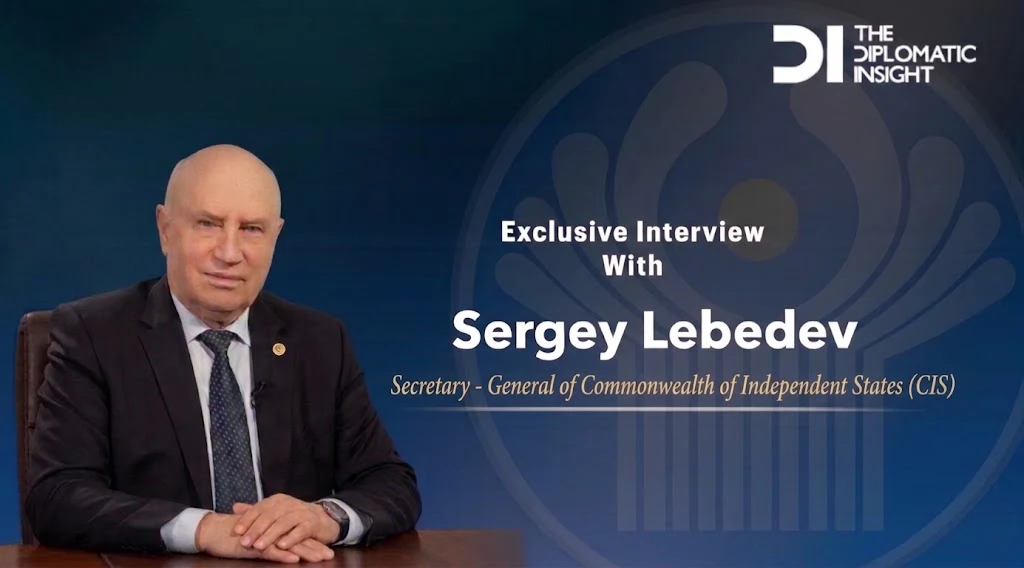
In this interview with The Diplomatic Insight, Sergey Lebedev, Secretary-General of Commonwealth of Independent States (CIS) reflects on the CIS’s founding logic, its economic and humanitarian achievements, and its vision for deeper global cooperation through 2035.
TDI: Tectonic shifts in the architecture of international relations were associated with the establishment of the Commonwealth of Independent States. New independent states emerged on the geopolitical landscape of Eurasia. How did the CIS region take its present shape? What had the greatest influence on this process? To what extent did your personal involvement in these processes shape the course of your career, eventually leading you to head the Commonwealth’s main executive body, which you have led for almost 20 years?
CIS Secretary General: The events of that period had a direct impact on the lives of millions of people. The new reality was radically different from what we had been used to. Many people feared losing forever their sense of belonging to a great country where people were not separated by borders. This was especially difficult for those whose families were divided, or who left their native regions to live in other republics.
My parents, who were Russians and came from Siberia and Leningrad (now St Petersburg), ended up living in Uzbekistan. I spent my childhood there and finished school there. I went to Ukraine to study at university, and later served in the army and worked there. When I was almost 30, I moved to Russia. At that time, it made little difference which republic you lived in; you could feel at home everywhere. However, everything changed in the early 1990s, and it inevitably left its mark on all of us. For me, preserving and strengthening ties between our countries became one of the most important things I have devoted my life to. I have spent almost 20 years working towards this goal.
The Commonwealth was established in 1991, and the Agreement on its establishment stated that the Soviet Union had ceased to exist. Shortly before that, all 15 Soviet republics had, at different times, adopted declarations of independence. Subsequently, 12 of them formed the CIS.
The Russian Federation, due to its size, strong economy and vast human potential, has always played a leading role in promoting integration within the Commonwealth. The five Central Asian states – Kazakhstan, Kyrgyzstan, Tajikistan, Turkmenistan, and Uzbekistan – are equally important to the integration process. It is no coincidence that the Alma-Ata Declaration, which largely completed the process of establishing the CIS, was signed in Alma-Ata, Kazakhstan, in 1991.
In 2009, Georgia left the CIS, and in 2026, Moldova formalized its intention to leave the Commonwealth. Ukraine does not participate in the work of CIS bodies either.
Nevertheless, as a geopolitical structure, the Commonwealth remains a robust entity. It is based on the enduring axis between Russia and Belarus and the deeply integrated Union State established by the two countries, on the comprehensive strategic partnership between Russia and the Central Asia states, and on a wide network of bilateral and multilateral cooperation among the CIS member states.
Thus, nine countries now make up the core of the Commonwealth.
TDI: The Commonwealth of Independent States, especially in its early stages, was often perceived as a ‘closed club of post-Soviet republics’ created for their ‘civilised divorce’. In your view, to what extent did these perceptions reflect the reality in the early years of the CIS, and what has changed since then?
CIS Secretary General: It is an undeniable fact that the Commonwealth was established by republics that had previously been part of the Soviet Union. They had to address many issues concerning the legacy of what had once been a single state.
In the economic sphere, it was necessary to preserve economic ties between enterprises that found themselves on opposite sides of the new borders. It was also necessary to coordinate the energy, transport and communications sectors, all of which are inherently cross-border in nature. These needs extended to most industries and areas of activity.
Many social issues could also only be addressed through coordinated efforts, including maintaining the free movement of citizens and access to employment for migrants, ensuring the payment of pensions and allowances to those who had moved from one country to another, and ensuring their access to education and healthcare, among other things. The end of a single state was not supposed to mean the loss of human contacts or severing of friendship and family ties.
In the security sphere, we had to re-establish cooperation between national law enforcement agencies to jointly combat cross-border crime. Joint and coordinated efforts were also made to protect the common external borders.
All these issues came under the purview of the CIS. By building their relations on the new principles of sovereign equality, the CIS member states developed a unique practice of jointly addressing a wide range of issues.
This enabled the CIS to successfully navigate the period when its member states were establishing their national statehood and move on to developing comprehensive cooperation among them.
From the very beginning, the Commonwealth was also designed as an open framework for cooperation. As the CIS Charter, adopted on 22 January 1993, states, any state that shares the goals and principles of the Commonwealth and undertakes the relevant obligations can become a member of the Commonwealth. The Charter also provides for associate membership. In recent years, the Observer and CIS Partner statuses have also been established, along with the CIS+ format. These new statuses and the CIS+ format can be applied not only to states but also to international organisations. In this context, it would be entirely wrong to describe the Commonwealth as a ‘closed club’.
TDI: New cooperation formats within the Commonwealth involve developing cooperation with new external partners. What cooperation mechanisms are used within the Commonwealth, and which of them do you think will be of greatest interest to states and organisations that are not currently involved in the CIS’s activities?
CIS Secretary General: It should first be noted that the Commonwealth was established at the same time as its member states were building their sovereign statehood. Particular attention was therefore paid to ensuring equality among the member states, regardless of the differences in their capabilities. Within the CIS, small and medium-sized states have the same voting rights and influence as Russia.
Consensus is the main principle of decision-making at all levels. A decision cannot be made if even one member state opposes it.
At the same time, another principle is widely applied in practice to prevent the Commonwealth’s work from being paralysed. If a member state does not object to a decision but does not intend to join it either, the decision will apply only to those states that supported it.
This approach has enabled the CIS to develop a model of free partnership in which each member state participates in cooperation to the extent that suits its interests and capabilities.
Over the years, the CIS has developed a multilevel system of relations among the member states, involving regular direct contacts between heads of state and government, representatives of other branches of government, sectoral ministries, regional authorities, business communities, and professional and creative communities.
A well-developed cooperation infrastructure provides the institutional basis for these horizontal contacts. A number of Commonwealth legal acts, particularly those governing sectoral cooperation, are already open to accession by third countries, often with the consent of the other parties involved. Examples include the Agreement on Joint Research and Use of Outer Space and the Agreement on Coordinating Interstate Relations in Postal and Electronic Communications.
Strategic cooperation issues are addressed by the Heads of State Council and the Heads of Government Council. Other bodies with broad mandates include the Council of Foreign Ministers, the CIS Economic Council, and the Commission on Economic Affairs under it.
Practical cooperation and the development and implementation of projects are carried out through 66 sectoral cooperation bodies, 35 of which operate in the economic sphere, 10 in the humanitarian sphere and 17 in the security sphere.
We believe that partners working within the new cooperation formats will be particularly interested in taking part, even if only to a limited extent, in the work of the highest bodies of the CIS, as well as in closer practical cooperation within its sectoral bodies, including the preparation and implementation of joint projects. This will enable them to quickly establish mutually beneficial multilateral relations with the CIS member states and achieve tangible results.
TDI: The CIS has been operating for 35 years. This is quite a long period. Has the Commonwealth already established cooperation with any external partners? With which partners could the Commonwealth take cooperation to a new level in the near future?
CIS Secretary General: The CIS has been cooperating productively with the United Nations and its specialised agencies for many years. On 24 March 1994, the CIS was granted observer status at the UN General Assembly and on 26 May 1996, the CIS Charter was registered with the UN Secretariat. Since 2014, the UN General Assembly has adopted biennial resolutions on cooperation between the United Nations and the CIS, recognizing the Commonwealth as a leading regional organisation in its part of the world. A further such resolution was adopted on 27 August 2025. The Commonwealth cooperates with the United Nations in areas such as economic development, environmental protection, humanitarian affairs and combating terrorism and extremism. The CIS has particularly close ties with the World Health Organization.
For almost 20 years, CIS structures have also been cooperating with specialised and working bodies of the Shanghai Cooperation Organisation (SCO), in which almost all CIS member states are represented in different capacities. The SCO is of particular importance to the CIS because it provides opportunities for the Commonwealth to coordinate its positions with emerging global powers such as China and leading regional powers, including Pakistan and Iran.
The Belt and Road Initiative, promoted within the SCO and widely supported by the CIS, is also of great importance. Its aim is to connect the economies of numerous countries across Asia and Europe.
The presence of Pakistan and Iran in the SCO is one of the factors contributing to constructive dialogue between these countries and the CIS member states, including on the operation of the International North-South Transport Corridor, which connects Russia, Belarus and other CIS member states with the Indian Ocean coast. It also contributes to improving transport connectivity between Central Asia and Pakistan, taking into account the transit potential of Afghanistan and Iran.
The growing cooperation between the CIS and the SCO in the field of security, together with their broad humanitarian and economic agenda, objectively helps strengthen cooperation between the two organisations. It is therefore no coincidence that, on 10 October 2025, the SCO became the first organisation to be granted observer status with the CIS.
As for the prospects for developing relations with new partners, these could well include major regional organisations such as the African Union and BRICS. We are also interested in expanding cooperation with countries neighbouring the CIS member states, as well as countries with which the CIS member states already have strong bilateral ties.
TDI: Economic integration remains one of the CIS’s key areas of activity. What do you consider to be the most significant achievements in strengthening economic cooperation among the CIS member states? What economic advantages does the Commonwealth offer potential external partners?
CIS Secretary General: The key achievements of economic cooperation include the largely unrestricted movement of goods, the preservation and further development of shared transport and energy infrastructure, close cooperation in communications and information and communication technologies, as well as in industries where small and medium-sized states may find it difficult to achieve significant results on their own. These include nuclear energy, space exploration and the use of space technologies, among others. A good example of such cooperation is the commissioning of a nuclear power plant in Belarus and the construction of one in Uzbekistan.
The results of economic integration are particularly evident in mutual trade among the CIS member states. In 2000, trade amounted to just over $43 billion, and over the following 25 years it nearly tripled.
Cooperation in financial and banking sectors also contributes to the growth of mutual foreign trade. At the same time, settlements between the member states are made mainly in national currencies.
The CIS free trade zone operates with minimal barriers, allowing for the largely unrestricted movement of goods and services. Moreover, the free trade area is open to accession by third countries.
The Commonwealth continues to be a region of strong economic growth, supported in part by broad opportunities to sell goods and services in partner countries. Growth rates are particularly impressive in Central Asia. Last year, GDP grew by 11.1% in Kyrgyzstan, 8.4% in Tajikistan, 7.7% in Uzbekistan and 6.5% in Kazakhstan.
The CIS has a clear vision for increasing the collective economic potential of its member states in the medium term, as reflected in the Strategy for Economic Development of the CIS until 2030.
It should be noted that one of the key growth factors identified in the Strategy is the introduction of digital solutions, technologies and services in industry, energy, transport, communications and digitalisation, the space sector, the agro-industrial sector and other areas of the economy, as well as in healthcare and social services. In 2025, the Heads of Government Council adopted the Strategy for Cooperation among the CIS Member States in the Development of Information Society and Digital Economy until 2035, together with the Action Plan for its implementation.
We believe that the Commonwealth is attractive to foreign partners because of its large internal market and opportunities to invest in dynamically developing sectors of industry, agriculture, transport, communications and services; establish joint ventures; attract investment; facilitate the mutual transfer of advanced technologies; and participate fully in the labour market.
The population of the Commonwealth’s nine main member states is now over 250 million. The potential of this large consumer market is underpinned by relatively high and rising income levels.
Overall, the Commonwealth is attractive to new partners because, unlike the stagnating groupings of major established economies, we are experiencing unprecedented rates of economic growth in areas where artificial sanctions restrictions are not imposed. At the same time, our cooperation is aimed at reducing economic imbalances between the countries involved rather than perpetuating neo-colonial practices. Investment opportunities in the CIS are never accompanied by political demands or interference in domestic affairs.
TDI: Cooperation among the CIS member states extends beyond the economic agenda. What other significant areas of cooperation would you highlight?
CIS Secretary General: The Commonwealth attaches great importance to strengthening trust between our countries. The foundation of this trust can only be a deep understanding of and mutual respect for the traditions and culture of our peoples. These priorities, together with the development of youth and educational exchanges, largely shape the focus of humanitarian cooperation in the CIS.
To understand what role the humanitarian agenda plays in our activities, it should be noted that the list of priority joint events in this area for the past two years alone includes more than 150 items. The most notable among them are the CIS Forum of Creative and Scientific Intellectuals, the CIS Congress of Teachers and Education Professionals, the CIS Forum of Scientists, the Cultural Capitals of the Commonwealth Interstate Programme and the Sports Capitals and Youth Capitals projects, the CIS Games, the development of the CIS Network University, the Stars of the Commonwealth Interstate Award, the Commonwealth of Debuts International Award and many other projects.
Each year, a particular theme is given a special attention in the humanitarian agenda. For example, 2024 was declared the Year of the Volunteer Movement in the CIS, and a significant part of our activities focused on developing the movement. Last year was the Year of 80th Anniversary of Victory in the Great Patriotic War – the Year of Peace and Unity in Combating nazism. This gave additional impetus to patriotic work and to efforts to preserve historical memory of the Second World War and the Soviet people’s contribution to the victory, as well as to honour the heroes and victims of the war. This year, the Year of Health Protection in the CIS is our main focus.
The Commonwealth’s activities cover many other areas of cooperation. It is safe to say that there are few intergovernmental organisations in the world whose activities are so comprehensive. This is precisely what makes the CIS such a unique project.
TDI: Looking ahead, how do you see the Commonwealth of Independent States developing further, and what message would you like to convey to the new generation of diplomats and leaders in international cooperation?
CIS Secretary General: It should be noted that many conceptual, strategic and programme documents adopted within the CIS already extend almost a decade into the future, to 2035. This gives us a fairly clear picture of the near future.
As for the further development of the CIS in the context of global developments, our main goal is to build a network of cooperation with regional organisations that share our peaceful, constructive and forward-looking goals and principles, at least within the Great Eurasia, and preferably on a global scale. Our experience of cooperation with the SCO is the first step in this direction. Further development of cooperation with the CICA, the ECO, ASEAN, SAARC and the African Union could be of considerable interest. We remain open to dialogue with European institutions, provided it is based on a genuine interest in an equal and mutually beneficial partnership rather than patronising instructions on how we should conduct our political and economic affairs.
We sincerely believe in the ability of humanity to find effective solutions to global challenges, resolve armed conflicts and build a lasting and just peace across the globe, creating a common space for sustainable development and prosperity based on the diversity of civilisations and cultures, mutual respect for each other’s values, cooperation, and friendship.